

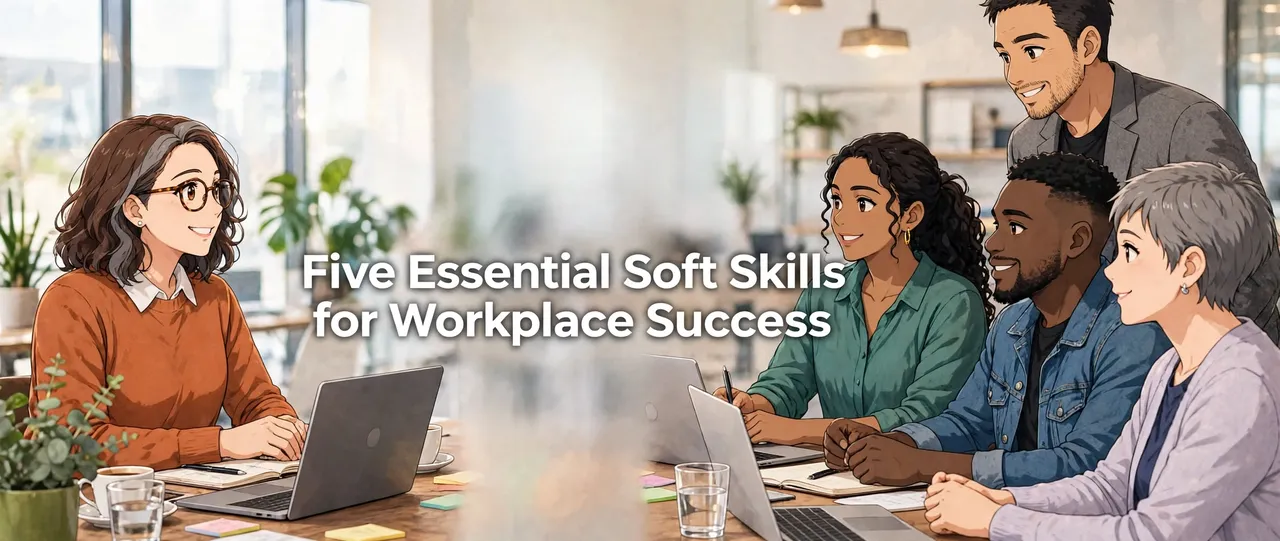
Five Essential Soft Skills for Workplace Success

Mr. Sengupta
Freelance Trainings Contributor
Ultimately, an employee cannot be successful in their professional career based only on their professional competence. Employees need to be able to communicate with each other, support their coworkers and have the capacity to adapt to the many demands they face in the professional environment. These communication and behavioural skills are called soft skills.
From the World Economic Forum and the International Labour Organization, during these times, it is essential that the modern workforce to possess communication skills, problem-solving skills, adaptability and teamwork.
1. Communication Skills
Good communication allows employees to pitch their ideas, clarify their roles, and prevent misunderstandings. Good communication refers to verbal communication, professional writing, listening and the delivery of confident presentations. Communication skills strengthen client relationships and can help coordinate activities on the job.
2. Working Well With Others
Good teams in a successful organisation have employees who can work towards common goals. Teamwork means sharing responsibilities, respecting different viewpoints, assisting others and taking part in group decisions.
3. Problem-Solving and Critical Thinking
Workers often have to deal with unanticipated circumstances and problems at work. Critical thinking skills allow them to process information, pinpoint the issues, consider options, and come to well-reasoned conclusions rather than jumping to conclusions.
4. Flexibility and Emotional Intelligence
The work culture, corporate role and business priorities are constantly changing and transforming. The skill of change is the ability of the individual to adapt to the new circumstances and conditions. The skill of emotion skills provides individuals with the possibility to understand their emotions, resolve conflicts and build better working relationships.
5. Leadership and Time Management
Leadership isn't reserved for managers. The ability to be proactive, accept accountability, inspire staff and make good decisions are applicable in any job. Time management pairs effectively with these skills by ensuring workers plan and complete their work on time.
Ways for Organisations to Learn These Skills
- Training: Businesses can build the skillset of their employees with workshops, mentoring, hands-on projects, and training schemes. Trainers in the corporate arena can try role plays, group activities, case studies, and onsite simulations.
- Communication, emotional intelligence, adaptability and problem solving organisational development is identified by the British Council.
Frequent review sessions and practical assessments allow managers to track employee development and target further assistance.
Conclusion
Soft skills can help improve your work. They can also improve your professional relationships and your long-term career prospects. Employers that foster an ongoing learning environment and give employees the chance to develop these five key skills will have more confident, flexible, and cooperative teams.